
Sound Healing and Meditation with Earth Tones
This Friday’s Sound Healing and Meditation with Earth Tones has been canceled due to low enrollment. We’ll be hosting them later this year and hope to see you then. Our apologies for any inconvenience this may cause.
30-Day Bodyweight Movement Revolution
Join us and one of the most fun and supportive global communities in this inspiring 30-day event!
For 30-min for 30-days, we invite you to explore bodyweight movement and share your experience with us. Let’s spread the word and create a bodyweight movement revolution!
Who can participate? Anyone can and is welcome to! You don’t need to be an athlete or have any prior bodyweight movement skills prior to joining.
What does it cost? Absolutely nothing. No gym membership required, no equipment required, just you and your environment.
What will you get out of this? The opportunity to connect with other fun loving individuals who are willing to express themselves through movement. You’ll be inspired by other people’s journeys and receive encouragement on your own journey. As an added bonus, you may find yourself trying things you’ve never tried before and find yourself connecting to your body in ways that you haven’t yet experienced. You may find yourself having fun with your “workout.” You may even lose a few pounds, gain some muscle, and realize strength you didn’t know you had.
What are the rules? They’re super simple and easy! Head on over and “like” our FB page.
For 30-days, spend 30-minutes participating in some sort of bodyweight movement. At the end of your session, post a photo of yourself doing a bodyweight movement activity that you explored during that time. At the end of each day, post your photo and your progress underneath your original post.
What qualifies as bodyweight movement? Anything you don’t need equipment or weights for (playground structures, rings, paralletes, pull up bars excluded). Some examples would be working on your squat, pistol squat, lunges, push ups and variations, pull ups and variations, mobility work, inversions and hand balancing, acro-yoga, martial arts, tai-chi, to name a few.
Do you have to do the same thing every day? Not at all, though you are more than welcome to. Down the road, we’ll have other events where we’ll invite you to explore a specific skill with us. For now, we want you to have fun playing, exploring, and connecting with this incredible community.
Have fun with it and have fun exploring! I’ll be participating in the event as well, so I’ll see you there.
What’s in your Water? Part 4
It’s pretty apparent that there are at least a few chemicals and/or by-products in our drinking water that perhaps we don’t want to be drinking. What can we do about it?
There are a few options, from bottled water to Britta filters, Zero water filters, to reverse osmosis, high quality countertop, under the sink, or whole house filters and purification systems. The process of deciding what works for you can be a bit daunting.
I invite you to consider a few points:
- how important is it to you to filter your water?
- how many people live in your home and will be using filtered water?
- how concerned are you about the environment and using plastics?
- does your town fluoridate?
- do you want to filter your drinking water to start with, or water in the entire home (including bath water)?
- how much money do you want/have to spend on a filtration system?
We’re all familiar with some of the pros and cons of bottled water. Some is no better, and at times worse, than tap water and it comes in this handy dandy plastic container that can leach chemicals into your drinking water and may wind up in a landfill. On the other hand, some bottled water is of higher quality than tap water and it’s convenient and may come in a glass bottle. At times, bottled water can be more acidic than alkaline. To combat this, add a pinch of high quality sea salt to your water.
Salt in water? Yes. It will make your water more alkaline and provide minerals to your body that may have been removed from the water during the filtering process and/or sweat out by you during exercise. I’m not talking table salt or Morton’s sea salt – what we’re familiar with as being good ol’ NaCl. Yep, sodium chloride. Sounds yummy, doesn’t it?! Mmm. Use a high quality Celtic sea salt or Himalayan sea salt. Your body will thank you.
Have you ever experienced drinking what seems to be a whole boat-load of water from the tap or bottled water, and yet not at all felt like it made the least bit of difference in your thirst? It’s probably acidic. Adding salt is likely to help.
Britta filters and Zero water filters can be fairly inexpensive in the beginning. How much are you paying for replacement cartridges each year? And, you guessed it, they do not remove fluoride. It’s an option for those tight on cash and for those whose town doesn’t fluoridate. Add a pinch of sea salt and you’re good to go.
Reverse osmosis (RO) systems can run anywhere from $150 for a countertop model upwards of $4000 for a whole house model. Things to consider with RO is whether or not the particular filters within the system you are considering purchasing also remove fluoride (if your town fluoridates). And, RO can make the water more acidic. So, add high quality sea salt to bring the water back towards alkalinity and to replace removed minerals.
There are numerous other models of water filters, including ones that specifically contain a filter for the removal of fluoride. Yay! Read carefully to make sure the filters you’re considering do what you want them to do. These models run anywhere from $110 up to $3000+ for a whole house filter. Some of these models re-mineralize the water. Do a test with pH to see if the water is acidic or alkaline. If it’s on the acidic end…you guessed it – add sea salt.
Many other options exist, but as you can see, there are options for nearly every budget and need.
Lastly, I often ask clients how much water they drink. Why? Approximately 60% of the human body contains water. 60%. So, if you’re not drinking enough, there’s no way you’ll be functioning at your optimum. What is enough? One-half of your body weight in liters. So, if you weigh 200 lbs, you should aim to drink 100L of water per day, adjusted for hot weather and activity.
If it’s colored, and not clear, it’s not water. It’s food!
I hope you enjoyed our little venture down the tributaries of the wonderful world of water. Let me know if you have any questions or comments. I’d be happy to hear from you!
What’s in your Water? Part 3
What’s in your Water? Part 3…FLUORIDE.
Well, water week has become a bit more than a week, it’s more like two weeks. My apologies for the delay in sharing information with you.
What is fluoride? According to the EPA, fluoride is “salts that form when fluorine combines with minerals in soil or rocks.” Why is it being added to the public water supply? To promote dental health. Why would dental health need to be promoted? It’s not that the water we’re drinking is full of tooth-rotting properties. Hmm. It wouldn’t have to do with the large consumption of white sugar and processed food, would it? If fluoride is safe to ingest (which is what we do when we drink water), why is it not safe to swallow toothpaste?
What are some potential health hazards of fluoride above “acceptable levels”?
– increased likelihood of bone fractures in adults (osteoporosis anyone?)
– “an increased chance of developing pit in the tooth enamel, along with cosmetic effects to teeth.”
– What can pits in tooth enamel lead to? Oh, that’s right, dental carries!
– What can untreated dental carries lead to? Cavities!
– neurotoxicity and reduced IQ in both adults and children
– certain types of cancer
– increase in autoimmune disorders
If the EPA currently views 4.0 mg/L as an acceptable level of fluoride, with a secondary, non-enforced level of 2.0 mg/L, why is it then that according to Choi, et al (2012), “the US Department of Health and Human Services (DHHS) and the US EPA recently announced that DHHS is proposing to change the recommended level of fluoride in drinking water to 0.7 mg/L from the currently recommended range of 0.7 – 1.2 mg/L, and the US EPA is reviewing the maximum amount of fluoride allowed in drinking water, which is currently set at 4.0 mg/L”? Why haven’t the levels been reduced, 2 years after the paper’s publication? Let’s think on that…
For more on fluoride, watch Fluoride: The Hard to Swallow Truth Documentary.
https://www.youtube.com/watch?v=7aTfyo0Xz_c
___________________________
References:
Beauchamp, J, Caufield, PW, Crall, JJ, Donly, K, Feigal, R, Gooch, B, Ismail, A, Kohn, W, Seigal, M, Simonsen, R. 2008. Evidence-Based Clinical Recommendations for the Use of Pit-and-Fissure Sealants. A Report of the American Dental Association Council on Scientific Affairs. Journal of the American Dental Association 209: 257-268.
Choi, AL, Sun, G, Zhang, Y, Grendjean, P. 2012. Developmental Fluoride Neurotoxicity: A Systematic Review and Meta-Analysis. Environmental Health Perspectives 120: 1362-1368.
EPA
Yiamouyiannis, John
Re-Birthing Breath-Work Workshop
We’re excited to welcome John “TheGreek” Tsafos, CEO of Holistic Wellness Network in Chatham, NJ, and incredible practitioner, for a special 3.5 – 4 hour Re-Birthing Breath Work Workshop on July 12.
If you have not yet experienced Re-Birthing Breath Work, here is your opportunity!
For more information and to register, see the flyer below or go to the Event page.

What’s in your Water? Part 2
What’s in your Water? Part 2
At the end of Monday’s blog, we brought today’s chemical of interest — lead — and how chloramines can increase lead levels in drinking water if the pipes are old and lined with lead. If you missed Monday’s post, you can read it here. I’ll wait.
According to the EPA, “lead is a toxic metal that is harmful if inhaled or swallowed.” Most lead concerns come from inhaling lead paint, dust, or swallowing lead that has leached into drinking water. If lead is inhaled, or if lead in drinking water is above acceptable limits, it can cause physical, mental, and learning delays in children as well as decreased attention span. In adults, it can cause high blood pressure and kidney problems.
The World Health Organization (WHO) states “too much lead can damage various systems of the body including the nervous and reproductive systems and the kidneys, and it can cause high blood pressure and anemia. Lead accumulates in the bones and lead poisoning may be diagnosed from a blue line around the gums. Lead is especially harmful to the developing brains of fetuses and young children and to pregnant women. Lead interferes with the metabolism of calcium and vitamin D.”
How does lead leach into drinking water? When water sits in leaded pipes for more than six hours, it can leach into the water supply.
What can be done about reducing lead in drinking water? There are filters and water purification systems which can help (more about those later this week).
If lead pipes, fittings, and fixtures are in your home but not the street and the lead content is greater than 15 ppb, it is recommended the following be done:
1. For drinking water and cooking with it, let the water run on cold for 1 – 2 minutes if the water has been off and sitting for more than 6 hours.
If the pipe entering your home from the street does contain lead, and the lead content is greater than 15 ppb, the following is recommended:
1. If the water has been turned off and sitting for more than 6 hours, turn high volume tap water (shower/tub) on cold and let it run for at least 5 minutes.
2. Run the tap in the kitchen on cold for 1 – 2 minutes.
3. Cook with only cold water from the tap, not hot as hot water contains increased lead levels.
If the lead content is less the 15 ppb, the EPA and CDC state that it is not necessary to take any additional measures to remove lead from the water.
In January 2014, new lead free requirements were enacted based on the Reduction of Lead in Drinking Water Act. Prior to January 2014, lead pipes, fittings, and fixtures could have a lead content of 8%. The new requirements mandate that all new pipes, fittings, and fixtures contain no more than 0.25% lead.
If you are unsure whether or not your community has header pipes containing lead, or if your home contains lead pipes, you can ask your local Water Quality/Resource Division.
__________________________________________________________________
Resources:
EPA
CDC
WHO
What’s in your Water? Part 1
What’s in your Water? Part 1
Yesterday, I posted a couple of pictures of the Water Quality Report, reporting year 2013, from the town I reside in.
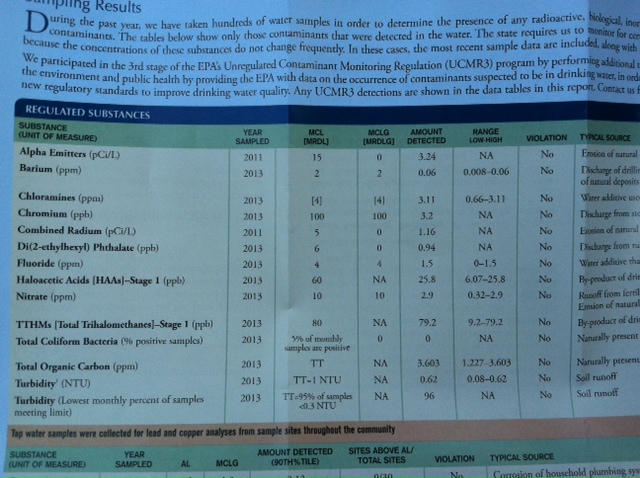
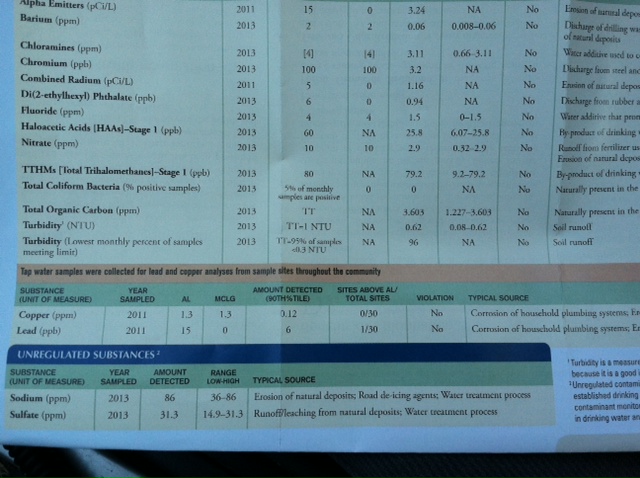
As you can see, the majority of the levels listed are within, albeit at the high end, EPA regulations. So, why may that be of concern? When is the water being tested? Where is it being tested? Is it tested immediately after treatment? Or, when the chemicals have dissipated?
The chemical of the day today is chloramines. Oooh, chloramines. What are chloramines? According to the EPA, “chloramines are disinfectants used to treat drinking water. Chloramines are most commonly formed when ammonia is added to chlorine…the most typical purpose of chloramines is to protect water quality as it moves through pipes.” Chloramines are used to decrease the number of potentially harmful disinfectant by-products (DBPs) from chlorine treated water.
What are DBPs? Richardson, et al (2012) states DBPs are “an unintended consequence of using chemical disinfectants to kill harmful pathogens in water. DBPs are formed by the reaction of disinfectants with naturally occurring organic matter, bromide, and iodide, as well as from anthropogenic pollutants.” According to the EPA, “water that contains chloramines and meets EPA regulatory standards is safe to use for drinking, cooking, bathing, and other household uses. ” Within the same pdf, the EPA states, more than once, that chloramines produce less regulated DBPs than chlorine. Regulated. The EPA was very clear on italicizing regulated. What about unregulated DBPs?
Researchers are finding that “several cases of emerging DBPs are increased in formation with the use of alternative disinfectants (e.g., chloramines), including nitrogen-containing DBPs (N-DBPs), which are generally more genotoxic and cytotoxic than those without nitrogen.” There have been a few studies in communities which show an increase in blood lead levels (BLLs) in children with the use of chloramines in drinking water. Miranda, et al (2007), states “introducing chloramines to reduce carcinogenic by-products may increase exposure to lead in drinking water.” But, water that contains chloramines and meets EPA regulatory standards is safe to drink…
Where is the water being tested? Are there lead pipes from the water supply source to your house, from your house to your faucet? Is the water testing division measuring lead levels in resident’s homes, particularly those who own older houses?
_________________________________________________________________________
Sources:
EPA
Miranda, ML, Kim, D, Hull, AP, Paul, CJ, Overstreet Galeano, MA. 2007. Changes in Blood Lead Levels Associated with Use of Chloramines in Water Treatment Systems. Environmental Health Perspectives 115(2): 221-225.
Richardson, SD and Postigo, C. 2012. Drinking Water Disinfection By-Products. Emerging Organic Contaminants and Human Health: The Handbook of Environmental Chemistry: 93-137.


 On A Limb Movement & Wellness