
10 Tips to Nourish Yourself – Part 2
Thanks for joining us again. If you missed Part 1, you can view it here.
Without further delay, here are tips 6-10:
6. Go outside and connect with nature.
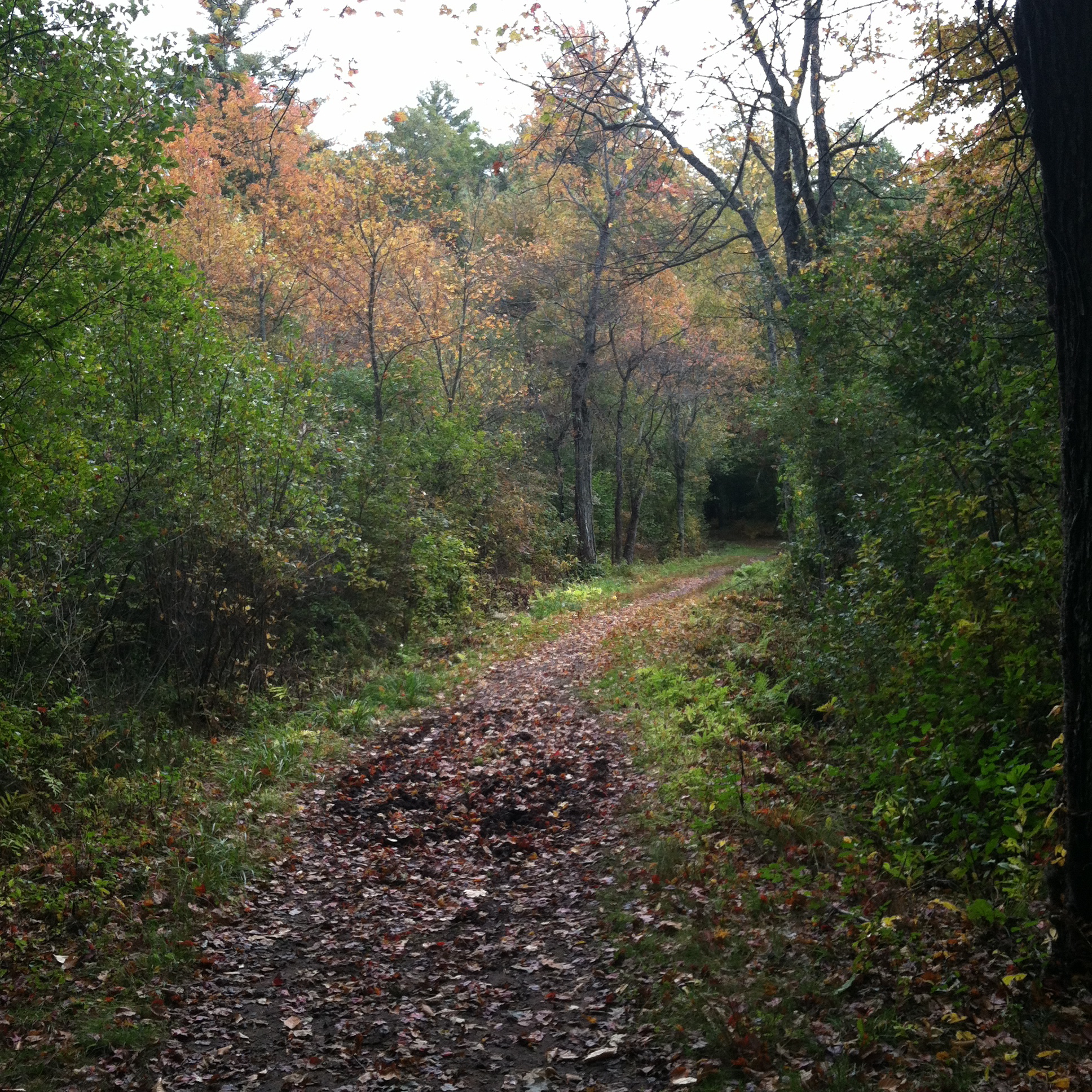 Have you ever laid upon the earth and noticed how incredible it feels to do so? When was the last time you watched the stars come out at night? The sun rise in the morning? We spend so much time, in general, surrounded by technology in our man made concrete jungle, that we have largely become disconnected from who and what we are. We are human beings, not human doings. Unplug. Go visit the forest, the beach, or the mountains. Kick your shoes off, close your eyes, and allow yourself to connect with the earth. You may notice you breathe more fully. Your stress may decrease significantly. Your mood may brighten, and you may feel more grounded. If you feel so bold and daring as to be called a tree-hugger by your friends, please do hug a tree. If you “listen” carefully, you can “hear” the flow of movement within the tree, “hear” it “speak.” Yes, I hug trees. Part of me feels ashamed to share that with you. Interesting.
7. Breathe.
Some would argue that this should be first on the list. Without breath, we would not be alive. So, breathing is just a little important.
When was the last time you allowed yourself to receive a deep breath? Can you receive a deep breath? Can you fully exhale? When you inhale, where do you breathe from? What is your belly doing? Are you a chest breather? A mouth breather? A noisy breather? Are you really breathing or do you just think you are breathing? Dysfunctional breathing patterns are a sign that your system, your body, is under stress.
I invite you to lie on your back, place a small sandbag, bag of rice, or herbal hot pack on your abdomen. Which direction does it move when you inhale? It should move up towards the ceiling. Draw your attention to your ribs. Are they expanding laterally? Posteriorly? Can you breath in 360°? I would like to invite you to take a few moments and breathe. Focus on slow, steady, quiet breathing, inhaling through the nose for a count of three, exhaling through the nose for a count of 5-6. You may find yourself experiencing emotions as you relax and let go. Allow yourself to feel them, to experience them, and let them go. Experience what it is like to feel, to receive and to give breath, and to relax.
8. Meditate.
Perhaps it would be worth exploring tips 6-8 together? Have you ever noticed how noisy our minds can be?! I don’t know about yours, but mind used to wander like crazy (and still does at times)! I would sit in meditation and find my mind wondering about what I had to do, what was going on in my life that was stressing me out, what to cook for dinner…inhale for three, exhale for six. Why can’t I relax? Breathe in, breathe out. Is this over yet? Has it been five minutes? My bum hurts and my feet are falling asleep. There goes my mind again. Monkey brain, monkey brain. Focus on the breath. Inhale, exhale. Inhale, exhale. Sound familiar? It does get easier.
Meditation has many benefits, including, but not limited to the following:
- reduces stress
- lowers high blood pressure
- decreases tension within the body
- increases serotonin
- increases the immune system’s ability to fight infection
- increases energy
- increases mental clarity
- increases emotional steadiness
There are numerous meditation apps out there. I invite you to try one and incorporate 5-10 minutes of daily meditation into your life. Who knows, it may just carry over into the amazing art of what I consider moving meditation, like what my friend Rusty is doing here:


9. Play and allow your inner child to express his/her unique, creative self.
Now we’re getting serious. When was the last time you played? Really played and had fun and allowed yourself to be wild and carefree? What were some of your favorite things to do as a child? I loved climbing on things, swinging, sitting under this huge blue spruce tree in the backyard and making mud pies, blowing bubbles and running around to pop them…
What would you do right here, right now if no one was watching that would invite your inner child to giggle with sheer delight? What’s stopping you from doing that? I’ll admit, this is a topic that likely has many layers to it and may very well warrant a post of its own.
One of the things my inner child likes to do is write. She also likes to swing, though I get nauseous if I swing for too long. She loved the experience of contradancing, and would probably enjoy contact improve…and, I’m a horrible dancer and haven’t done it in a long time. She likes to climb on things, slide down slides, and be upside down on her hands. She loves to laugh and laugh with you.
What are some things you could do right here, right now that would allow your unique inner child to express him/herself through you? I’d love to hear about it from you. You won’t be judged, even if it means catching frogs or, holding a pumpkin and acting like it’s a microphone. Go for it and have fun!


10. Ask yourself what makes you happy and go do it.
What invites you to feel happy? Only you can answer this. What can you do for yourself to welcome more happiness into your life? Do you feel happy? Do you really feel happy or are you in denial that you are unhappy? I’m curious, what does true happiness mean to you?
This isn’t a fake it until you make it post. I’m inviting you to consider one thing, just one that invites you to feel happy. One thing that invites me to feel happy is taking care of myself and moving my body every day. Another is spending time connecting with people I love and care for. I would like to invite you to spend some time every day doing one thing that invites you to experience happiness.
Bonus:
11. Be curious about yourself.
Have you noticed how certain patterns may reappear in your life? Have you noticed that sometimes you are triggered for no reason whatsoever or that seemingly trivial situations leave you worked up and in a tizzy? Have you wondered about your dreams and what they may be telling you?
Would you consider being curious about yourself? What does that mean? Rather than rationalizing and accepting things at face value, would you consider asking yourself “why”? Would you consider asking yourself “what”? Would you consider asking yourself “is this true,” or “is this for my highest good at this moment in time”? I’ll admit that asking questions often leads to more questions and few answers. However, the answers are sometimes in the questions themselves. By remaining curious about ourselves, we may open ourselves up to a realm of possibility that may not be realized otherwise.
How do you nourish yourself? I would enjoy hearing from you below. Please feel free to share some of the ways you nourish yourself. If you find that you’re not nourishing yourself or don’t know where to start, please shoot me an email. I’d be happy to help guide you.
10 Tips to Nourish Yourself – Part 1
How are you at taking care of, well, you? Are you caring for yourself as well as you could be or should be? I’ll be the first to admit that sometimes I fall short of nourishing myself. After mildly injuring myself last week, I found myself asking myself those questions.
If we have a bit too much go-go and do-do in our lives, then we may find ourselves setting ourselves up for the opportunity for a bit of doodoo to land in our face, our lap, or on the bottom of our shoes. When that happens, life can become rather stinky. To help keep the roses smelling rosy and the air fresh and crisp (Don’t you just love autumn?), to find more balance and nourish yourself, check out these 10 tips:
1. Drink quality water.
A lot of seemingly unconnected symptoms may be connected to dehydration. Drink water and you may find yourself feeling better. A good rule of thumb, and this is just a guideline mind you, everyone has their own unique needs, is to drink 1/2 your bodyweight in ounces of water. This is different for those who use kg for bodyweight…in that case it’s closer to a 1:1 ratio. For example, if you weigh 180 lbs, a guideline is to drink 90 ounces water. Again, this is just a rough guideline. You may need more or less depending on your body and its needs. By the way, if it’s not clear, it’s not water, it’s food.
2. Eat quality, wholesome food from healthy plants and animals.
You are what you eat. If you eat diseased animal, you get diseased animal. If you eat diseased plants, you get diseased animal. If you eat pesticide laden food, you get a toxic animal. If you eat crap, well, you get crap. Got it? It’s not necessary to be perfect all the time. Who doesn’t enjoy a treat every now and then? I’d recommend aiming to eat well and healthy 80% of the time.
Three of our favorite nourishing foods (note, foods, not meals) are the following:
- Cate Stillman‘s Boo Candy to help ward off colds and mucous
- Turmeric Milk
- Beef Bone Broth. Although I usually keep mine to the bare basics, here’s a “recipe” from the Weston A. Price Foundation.
Not only are they nourishing from a nutritional standpoint, they are also what I would consider “soul food.”
3. Develop a relationship with your food.
Turn the TV off. Set the computer and iThingys aside. Put the newspaper, magazine, or book down. Disconnect from your disconnections and connect with your food and the people who may be sitting in front of or next to you. You may find yourself chewing your food more thoroughly, tasting what you are eating, getting more full sooner, and maybe, just maybe sharing a conversation. I would invite you to consider chewing your food until it is liquid or nearly so. As Paul Chek says, “Drink your food. Chew your water.”
4. Sleep.
That’s a shocker! Yes, we need sleep. Quality sleep. How well and how long you sleep for you (everyone has their individual needs), will impact your health and well-being. If you’ve been experiencing yourself short of temper, prone to emotional outbursts, facing difficultly thinking clearly, feeling sluggish in the gym…sleep, or lack thereof, may be a contributing factor.
5. Move.
In my opinion, don’t just move. Ask yourself why you are moving your body. What are you moving for? What are you hoping to get out of moving your body? Are you beating yourself up in the gym or doing endless hours of cardio? Are you burning yourself out? Maybe you need to slow down and invite more yin-like movements into your day. High intensity go-go, more, more, harder, harder, and faster, faster isn’t often what our bodies need. They need balance. If your life and job are super stressful, maybe stressing yourself physiologically is pushing you over the edge. Check out these videos by my dear teacher and friend Benny Fergusson of Cohesion Gym for a quick glimpse into this topic. Although I see it far less often, maybe you need to move more. If you’re finding difficultly finding balance, I invite you to reach out to a holistic movement specialist who can guide you to bring balance back into your movement and your life.
Click here for Part 2, after you watch the videos.
Confessions from a Recovering Asana Junkie – Part 3
If you missed Part 1, click here; Part 2, click here. I’ll wait…
I’d show up to each and every class with this desire to connect. I wanted to experience what the teachers were talking about – that physical asana is a means to connect to ones higher Self. But, I never felt it. I’d push and push and push to feel this connection, or I’d fervently pray, but all I felt inside was an empty shell of nothingness. That’s right. NOTHING.
You want to talk about a void? Well, there it was and I was trying to fill it with these false notions of connecting to something greater than myself through yoga. I was trying to fill the void with the deep, dark shadow emotions I was feeling. And, I was trying to fill it with a community that largely doesn’t see you, doesn’t reach out to you unless you are there in class. You see, I realized that a part of me would feel like I would not exist if I didn’t do yoga. So, I filled that void by making sure I would exist by showing up all the time.
I continued down this path until I broke. I broke myself. The container with which I was feeding my toxic shame, the container with which I was stuffing my shadow emotions broke.
I injured myself. Granted, yes, it was a physical injury, but that has been nothing compared to the immense inner wounding that I did to myself during the “healthy” practice of yoga. I kept practicing for a while anyway. I kept showing up. I still tried to fill the broken vase of my inner world with pain or with the intention that “all you need to do is send that part of yourself love and compassion.”
Bull crap. Sometimes, oftentimes, we need to allow ourselves to feel the pain inside of us, and
 express it. Sometimes we need to experience hating parts of our self so that we may in turn learn to accept our self, or accept the parts of our self which we cannot accept, so we may learn how to love ourselves. Sometimes, we need to step away from the picture and take a look at just how much of our practice is unconsciously filled with sugar coated shit and namaste’s that have become so overused that it now has the equivalent weight of “hello.”
There were so many times after this injury where I would try to continue practicing, but the pain I felt become too intense. Yes, there was a physical pain, but the emotional pain could no longer be held by the broken container within which I stuffed it, so it began to overflow. I stopped practicing yoga a few years ago and began my journey to healing myself. At first, all I wanted to do was yoga. If I wasn’t doing yoga, I wasn’t happy. If I was doing yoga, I wasn’t happy…isn’t that interesting. The last spontaneous class I took, a year ago, to test myself, revealed much.
I learned that the yoga asana I have experienced doesn’t support me, doesn’t support my body, doesn’t support who I AM. I learned that I could no longer listen to themes of a physical practice connecting us to Source. I stopped drinking the Kool-Aid, the alcohol of yoga, the cocaine of yoga. Parts of me experienced anger when asked when I would return to class. I don’t have an answer to that question. At this point in time, returning to a yoga asana practice or class would be akin to a recovering alcoholic having a drink, a recovering cocaine addict a hit.
Why share this with all of you? Perhaps my story will inspire you to look closely at your practice. Perhaps my story will plant the seed of awakening to the parts of yourself who may be in denial about the possibility of addiction through yoga. And, part of me is allowing myself to heal, to more fully accept myself, to more fully love myself, by sharing my story with you.
May I share something else with you? Each and every one of us is already infinitely connected. You don’t need to go out and buy fancy Lululemon pants. You don’t need to drop “namaste” like it’s the hottest thing since sliced bread. You don’t need to stop eating meat because you believe not eating it will increase your vibration and make you more enlightened. I invite you to be. Just be and allow yourself to experience your Self as you are. Here and now.
If none of this has a ring of truth to you, I would invite you to consider watching and experience this funny, not-so-funny, funny video “How to be Ultra-Spiritual” by friend and mentor JP Sears.
Confessions from a Recovering Asana Junkie – Part 2
If you’re just joining us now, please take a moment and read Confessions from a Recovering Asana Junkie – Part 1.
I was one of “those” people. Yes, I wore Lululemon pants. Not because I felt they’d make me a better yogi or grant me enlightenment, but because they fit. And, they lasted several years before wearing out. Maybe I’m in denial about some expensive pair of pants making me feel more spiritual.
Anyway, I was one of those people whom you would see in yoga class at least three times per week. I’d practice at home anywhere from 1-3 hrs. per day. I’d take every single workshop that I could. Part of me would hang on and hope to be included in the “Insider’s Club” so I could be one of the “cool kids” who got to hang out with the crew and chat about…yoga. I wanted to fit in and an unconscious part of me would do anything that I had to in order to feel connected and like I belonged.
Very rarely did I leave class with one of those post yoga glows. If I did, it was usually a physiological response resulting from my having moved my body through space and time. Yoga became my means of brutalizing myself. It became my means of beating parts of myself up. It became my means of reaffirming over and over and over again the toxic shame that I would never be enough as I am.
If I couldn’t do a pose, I unconsciously believed there was something wrong with me. If my alignment wasn’t perfect, I unconsciously believed there was something wrong with me. If I didn’t leave with this blissed out look and happy as a clam, feeling so connected to Source that I was flying on the inside, then there was absolutely, positively something wrong with me. I believed I’d never measure up and that’s exactly what my ego wanted. (Little did I know that that’s what it wanted.).
There would be times when parts of me would feel so angry that I could have screamed for days.
There were times when parts of me would feel so sad and I would be hurting so much on the inside, that I could have cried and cried and cried for days on end.
But, yogis are supposed to be calm, and zen-like. They’re not supposed to feel these tornadic waves of emotion. Nope, not allowed. At least, I didn’t believe so. That fit in perfectly with the part of myself that had become very safe and comfortable not feeling and not expressing emotions. Feeling and showing emotions? Geesh. That’s scary business!
If you’re teacher says it’s ok to cry on your mat, is it really ok? Let’s face it, the reality of someone hysterically sobbing next to you, while you’re trying to rest in savasana, isn’t always the most welcome activity. So, what did I do? I stuffed those emotions down inside of me. I knew how I felt – that maybe I would explode. Heck, there were times when you could physically see it! My face, neck, and upper chest would be red as a beet, with a distinct line across my chest showing the energy blockage. I felt on fire.
To make matters worse, I fell into the dangerous trap of intellectualizing my emotions. “I feel like I can’t move forward in my life. I must be experiencing Ganesh energy. I need to find a way around the elephant standing in my path.” Or, “I feel like I’m being broken down and torn apart…Om Namah Shivaya, Om Namah Shivaya…”. Or, “Why can’t I feel boundless love within my heart? Hanuman, help me please.” What?! You want to talk messed up – that was me. I rationalized my emotions. What did that do?
It gave me an out so I could continue to numb myself from experiencing the experience of feeling the intense emotions that I had consciously and unconsciously spent the majority of my life burying. Yoga become a tool, a means, my drug, my drink, to numb myself from the reality of my life. Woah.
Click here for Confessions of a Recovering Asana Junkie – Part 3.
Click here for Confessions of a Recovering Asana Junkie – Part 1.
Confessions from a Recovering Asana Junkie – Part 1

You walk into a room, most likely with hardwood floors, soft bright lighting, perhaps some buddhist or zen-like paintings on the wall. Maybe Nag Champa or some other incense is burning. Krishna Das, Wah, or Snatam Kaur may be on in the background. You take note of the myriad of mats laid out across the floor with people vying for “their spot.” You notice the class is largely filled with Lululemon-clad women and a few men. Perhaps they’re stretching themselves out in downward facing dog or chatting with each other about some mystical experience they had and how it relates to a theme from yesterday’s class, or a Hindu god/dess…
 Class begins, perhaps with a meditation and centering, maybe with a chant, and almost definitely with three Oms. You are led through a sequence of poses that may or may not build up to a pinnacle pose, depending on which style of yoga you are practicing, or maybe you’re moving your body in a 100°F room to “detox” and become more limber. At the end, class is wrapped up with savasana, followed by the ever popular “namaste.” Maybe, just maybe you’re one of those folks who leaves class all blissed out with this incredible post-yoga glow on your face. After class, you and your yoga family head out to the nearest healthy eatery and continue sharing conversation that inevitably resolves around something having to do with yoga. After all, that’s all there is to life, isn’t there?
I have a confession to share with you. My name is Amanda and I am a recovering asana junkie. Yes, I was a yoga addict. What is an addiction? The American Society of Addiction Medicine (ASAM) defines addiction as the following:
“a primary, chronic disease of brain reward, motivation, memory and related circuitry. Dysfunction in these circuits leads to characteristic biological, psychological, social, and spiritual manifestations. This is reflected in an individual pathologically pursuing reward and/or relief by substance use and other behaviors.
Addiction is characterized by the inability to consistently abstain, impairment in behavioral control, craving, diminished recognition of significant problems with one’s behaviors and interpersonal relationships, and a dysfunctional emotional response. Like other chronic disease, addiction often involves cycles of relapse and remission…”.
How does that invite you to feel? What are you experiencing in this moment? Are you uncomfortable? Perhaps you are thinking – how can something that is healthy be an addiction? Sure, it’s possible to have too much of a good thing, like eating that extra piece of raw cacao and maybe not feeling so hot afterwards, but addicted to yoga? How is that possible?
May I ask you a question? If you’re a “yogi,” are you addicted to yoga, not addicted to yoga, or are you in denial about your addiction to yoga? Hmm…
Click here for Confessions from a Recovering Asana Junkie – Part 2.
Click here for Confessions from a Recovering Asana Junkie – Part 3.
Welcome the New Members of the On A Limb Team
We’re excited to introduce you to two new practitioners here at On A Limb! Please join me in welcoming Sally Palmer of Revive Mindfulness, LLC, and Erin Rossi.
 Sally comes to us with a background in mindfulness education and training for stress reduction. She has practiced yoga since 2008 and mindfulness meditation since 2010. She completed the Practicum in Mindfulness-Based Stress Reduction (MBSR) at UMass Medical School and has attended retreats at the Insight Meditation Center in Barre, MA. Sally plans to continue her studies with UMass Medical School, Center for Mindfulness in Medicine, Health Care and Society.
This fall, she is offering a 6 week class – Mindful Living and Stress Reduction, Thursday evenings Oct. 2 – Nov. 6
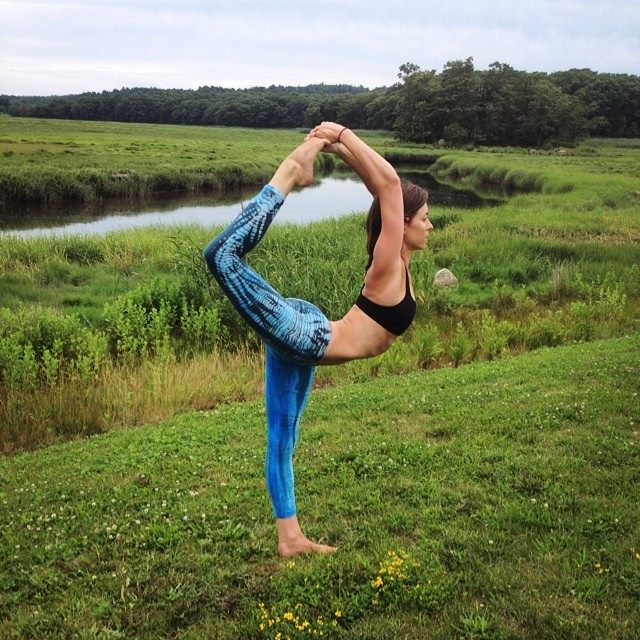 Erin joins us with a 15 year background in yoga and movement. She studied ballet in her early years and found yoga as a compliment to dance in her late teens. Erin has over 400 hours of teacher training and has studied with many master teachers in a variety of styles.
Erin is grateful for and passionate about these teachings. By finding a balance in the physical body and cultivating a deeper awareness on the mat, Erin’s hope is that you will become more empowered and connected to an inner wisdom and sense of ease that translates into your daily life and interactions – an alchemy of sorts.
We hope you’ll join Erin for her 6 week class – Dynamic Vinyasa on Tuesday afternoons, Sept. 30 – Nov. 4.
Mindful Movement, Handstand and Parallettes Workshop
Hi there On A Limb-ers. I’m excited to share with you two upcoming workshops led by Gold Medal Bodies (GMB) guest coach Daniel Spencer of Dynamic Movement Solutions.
On Sat., Oct. 4, we hope you’ll join us for a 4-hr workshop – Mindful Movement and Handstand Fundamentals. If you haven’t yet explored movement and handstands “Gold Medal Bodies style”, or are looking to refine your technique and add to your skills, then this event is for you. You do not need to be able to hold a handstand in order to attend, nor have any prior movement experience (though it’s helpful to have some).
On Sun., Oct. 5, we’re offering a 2 – 2.5 hr workshop – Mindful Movement and Parallette Fundamentals. If you’ve been wondering what this little piece of equipment is for, are looking for a total body workout that is guaranteed to challenge your core and upper body strength all while having fun, or are a seasoned practitioner, this event is for you. You do not need prior parallette or hand balancing experience in order to attend.
By popular request, we have three different event options for you. You can register individually for the Mindful Movement and Handstand Fundamentals Workshop or the Mindful Movement and Parallette Fundamentals Workshop. Or, you can register for the full weekend Mindful Movement, Handstands and Parallettes Fundamentals Weekend Workshop.
We are offering an early registration discount for the individual workshops through Sept. 4 and a $50 discount (with no “expiration”) if you register for the full weekend. Since space is limited, pre-registration is required for all events.
If you’re curious about Daniel, check out this video where GMB provides a trainer spotlight on him:
If you’re excited and rearing to start practicing handstand and parallette training, here are two free videos to explore and play with from GMB. Or, you can come to our Intro to Movement & Calisthenics Class on Saturdays or our Movement & Calisthenics Class Mon., Wed., and Fri. beginning Sept. 3. Have fun and keep moving!
Sound Healing and Meditation with Earth Tones
This Friday’s Sound Healing and Meditation with Earth Tones has been canceled due to low enrollment. We’ll be hosting them later this year and hope to see you then. Our apologies for any inconvenience this may cause.
30-Day Bodyweight Movement Revolution
Join us and one of the most fun and supportive global communities in this inspiring 30-day event!
For 30-min for 30-days, we invite you to explore bodyweight movement and share your experience with us. Let’s spread the word and create a bodyweight movement revolution!
Who can participate? Anyone can and is welcome to! You don’t need to be an athlete or have any prior bodyweight movement skills prior to joining.
What does it cost? Absolutely nothing. No gym membership required, no equipment required, just you and your environment.
What will you get out of this? The opportunity to connect with other fun loving individuals who are willing to express themselves through movement. You’ll be inspired by other people’s journeys and receive encouragement on your own journey. As an added bonus, you may find yourself trying things you’ve never tried before and find yourself connecting to your body in ways that you haven’t yet experienced. You may find yourself having fun with your “workout.” You may even lose a few pounds, gain some muscle, and realize strength you didn’t know you had.
What are the rules? They’re super simple and easy! Head on over and “like” our FB page.
For 30-days, spend 30-minutes participating in some sort of bodyweight movement. At the end of your session, post a photo of yourself doing a bodyweight movement activity that you explored during that time. At the end of each day, post your photo and your progress underneath your original post.
What qualifies as bodyweight movement? Anything you don’t need equipment or weights for (playground structures, rings, paralletes, pull up bars excluded). Some examples would be working on your squat, pistol squat, lunges, push ups and variations, pull ups and variations, mobility work, inversions and hand balancing, acro-yoga, martial arts, tai-chi, to name a few.
Do you have to do the same thing every day? Not at all, though you are more than welcome to. Down the road, we’ll have other events where we’ll invite you to explore a specific skill with us. For now, we want you to have fun playing, exploring, and connecting with this incredible community.
Have fun with it and have fun exploring! I’ll be participating in the event as well, so I’ll see you there.
What’s in your Water? Part 4
It’s pretty apparent that there are at least a few chemicals and/or by-products in our drinking water that perhaps we don’t want to be drinking. What can we do about it?
There are a few options, from bottled water to Britta filters, Zero water filters, to reverse osmosis, high quality countertop, under the sink, or whole house filters and purification systems. The process of deciding what works for you can be a bit daunting.
I invite you to consider a few points:
- how important is it to you to filter your water?
- how many people live in your home and will be using filtered water?
- how concerned are you about the environment and using plastics?
- does your town fluoridate?
- do you want to filter your drinking water to start with, or water in the entire home (including bath water)?
- how much money do you want/have to spend on a filtration system?
We’re all familiar with some of the pros and cons of bottled water. Some is no better, and at times worse, than tap water and it comes in this handy dandy plastic container that can leach chemicals into your drinking water and may wind up in a landfill. On the other hand, some bottled water is of higher quality than tap water and it’s convenient and may come in a glass bottle. At times, bottled water can be more acidic than alkaline. To combat this, add a pinch of high quality sea salt to your water.
Salt in water? Yes. It will make your water more alkaline and provide minerals to your body that may have been removed from the water during the filtering process and/or sweat out by you during exercise. I’m not talking table salt or Morton’s sea salt – what we’re familiar with as being good ol’ NaCl. Yep, sodium chloride. Sounds yummy, doesn’t it?! Mmm. Use a high quality Celtic sea salt or Himalayan sea salt. Your body will thank you.
Have you ever experienced drinking what seems to be a whole boat-load of water from the tap or bottled water, and yet not at all felt like it made the least bit of difference in your thirst? It’s probably acidic. Adding salt is likely to help.
Britta filters and Zero water filters can be fairly inexpensive in the beginning. How much are you paying for replacement cartridges each year? And, you guessed it, they do not remove fluoride. It’s an option for those tight on cash and for those whose town doesn’t fluoridate. Add a pinch of sea salt and you’re good to go.
Reverse osmosis (RO) systems can run anywhere from $150 for a countertop model upwards of $4000 for a whole house model. Things to consider with RO is whether or not the particular filters within the system you are considering purchasing also remove fluoride (if your town fluoridates). And, RO can make the water more acidic. So, add high quality sea salt to bring the water back towards alkalinity and to replace removed minerals.
There are numerous other models of water filters, including ones that specifically contain a filter for the removal of fluoride. Yay! Read carefully to make sure the filters you’re considering do what you want them to do. These models run anywhere from $110 up to $3000+ for a whole house filter. Some of these models re-mineralize the water. Do a test with pH to see if the water is acidic or alkaline. If it’s on the acidic end…you guessed it – add sea salt.
Many other options exist, but as you can see, there are options for nearly every budget and need.
Lastly, I often ask clients how much water they drink. Why? Approximately 60% of the human body contains water. 60%. So, if you’re not drinking enough, there’s no way you’ll be functioning at your optimum. What is enough? One-half of your body weight in liters. So, if you weigh 200 lbs, you should aim to drink 100L of water per day, adjusted for hot weather and activity.
If it’s colored, and not clear, it’s not water. It’s food!
I hope you enjoyed our little venture down the tributaries of the wonderful world of water. Let me know if you have any questions or comments. I’d be happy to hear from you!
What’s in your Water? Part 3
What’s in your Water? Part 3…FLUORIDE.
Well, water week has become a bit more than a week, it’s more like two weeks. My apologies for the delay in sharing information with you.
What is fluoride? According to the EPA, fluoride is “salts that form when fluorine combines with minerals in soil or rocks.” Why is it being added to the public water supply? To promote dental health. Why would dental health need to be promoted? It’s not that the water we’re drinking is full of tooth-rotting properties. Hmm. It wouldn’t have to do with the large consumption of white sugar and processed food, would it? If fluoride is safe to ingest (which is what we do when we drink water), why is it not safe to swallow toothpaste?
What are some potential health hazards of fluoride above “acceptable levels”?
– increased likelihood of bone fractures in adults (osteoporosis anyone?)
– “an increased chance of developing pit in the tooth enamel, along with cosmetic effects to teeth.”
– What can pits in tooth enamel lead to? Oh, that’s right, dental carries!
– What can untreated dental carries lead to? Cavities!
– neurotoxicity and reduced IQ in both adults and children
– certain types of cancer
– increase in autoimmune disorders
If the EPA currently views 4.0 mg/L as an acceptable level of fluoride, with a secondary, non-enforced level of 2.0 mg/L, why is it then that according to Choi, et al (2012), “the US Department of Health and Human Services (DHHS) and the US EPA recently announced that DHHS is proposing to change the recommended level of fluoride in drinking water to 0.7 mg/L from the currently recommended range of 0.7 – 1.2 mg/L, and the US EPA is reviewing the maximum amount of fluoride allowed in drinking water, which is currently set at 4.0 mg/L”? Why haven’t the levels been reduced, 2 years after the paper’s publication? Let’s think on that…
For more on fluoride, watch Fluoride: The Hard to Swallow Truth Documentary.
https://www.youtube.com/watch?v=7aTfyo0Xz_c
___________________________
References:
Beauchamp, J, Caufield, PW, Crall, JJ, Donly, K, Feigal, R, Gooch, B, Ismail, A, Kohn, W, Seigal, M, Simonsen, R. 2008. Evidence-Based Clinical Recommendations for the Use of Pit-and-Fissure Sealants. A Report of the American Dental Association Council on Scientific Affairs. Journal of the American Dental Association 209: 257-268.
Choi, AL, Sun, G, Zhang, Y, Grendjean, P. 2012. Developmental Fluoride Neurotoxicity: A Systematic Review and Meta-Analysis. Environmental Health Perspectives 120: 1362-1368.
EPA
Yiamouyiannis, John
Re-Birthing Breath-Work Workshop
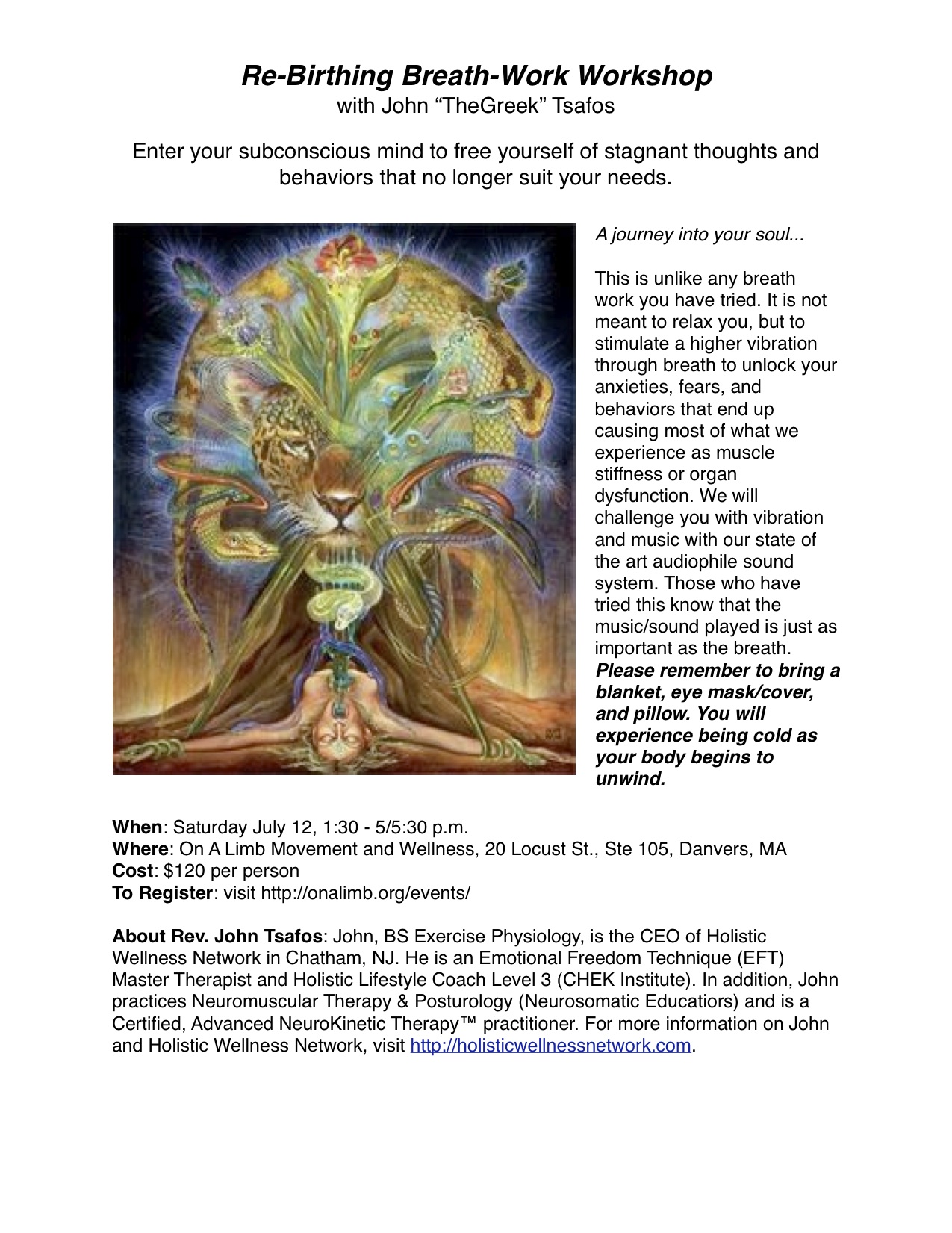
We’re excited to welcome John “TheGreek” Tsafos, CEO of Holistic Wellness Network in Chatham, NJ, and incredible practitioner, for a special 3.5 – 4 hour Re-Birthing Breath Work Workshop on July 12.
If you have not yet experienced Re-Birthing Breath Work, here is your opportunity!
For more information and to register, see the flyer below or go to the Event page.
What’s in your Water? Part 2
What’s in your Water? Part 2
At the end of Monday’s blog, we brought today’s chemical of interest — lead — and how chloramines can increase lead levels in drinking water if the pipes are old and lined with lead. If you missed Monday’s post, you can read it here. I’ll wait.
According to the EPA, “lead is a toxic metal that is harmful if inhaled or swallowed.” Most lead concerns come from inhaling lead paint, dust, or swallowing lead that has leached into drinking water. If lead is inhaled, or if lead in drinking water is above acceptable limits, it can cause physical, mental, and learning delays in children as well as decreased attention span. In adults, it can cause high blood pressure and kidney problems.
The World Health Organization (WHO) states “too much lead can damage various systems of the body including the nervous and reproductive systems and the kidneys, and it can cause high blood pressure and anemia. Lead accumulates in the bones and lead poisoning may be diagnosed from a blue line around the gums. Lead is especially harmful to the developing brains of fetuses and young children and to pregnant women. Lead interferes with the metabolism of calcium and vitamin D.”
How does lead leach into drinking water? When water sits in leaded pipes for more than six hours, it can leach into the water supply.
What can be done about reducing lead in drinking water? There are filters and water purification systems which can help (more about those later this week).
If lead pipes, fittings, and fixtures are in your home but not the street and the lead content is greater than 15 ppb, it is recommended the following be done:
1. For drinking water and cooking with it, let the water run on cold for 1 – 2 minutes if the water has been off and sitting for more than 6 hours.
If the pipe entering your home from the street does contain lead, and the lead content is greater than 15 ppb, the following is recommended:
1. If the water has been turned off and sitting for more than 6 hours, turn high volume tap water (shower/tub) on cold and let it run for at least 5 minutes.
2. Run the tap in the kitchen on cold for 1 – 2 minutes.
3. Cook with only cold water from the tap, not hot as hot water contains increased lead levels.
If the lead content is less the 15 ppb, the EPA and CDC state that it is not necessary to take any additional measures to remove lead from the water.
In January 2014, new lead free requirements were enacted based on the Reduction of Lead in Drinking Water Act. Prior to January 2014, lead pipes, fittings, and fixtures could have a lead content of 8%. The new requirements mandate that all new pipes, fittings, and fixtures contain no more than 0.25% lead.
If you are unsure whether or not your community has header pipes containing lead, or if your home contains lead pipes, you can ask your local Water Quality/Resource Division.
__________________________________________________________________
Resources:
EPA
CDC
WHO
What’s in your Water? Part 1
What’s in your Water? Part 1
Yesterday, I posted a couple of pictures of the Water Quality Report, reporting year 2013, from the town I reside in.
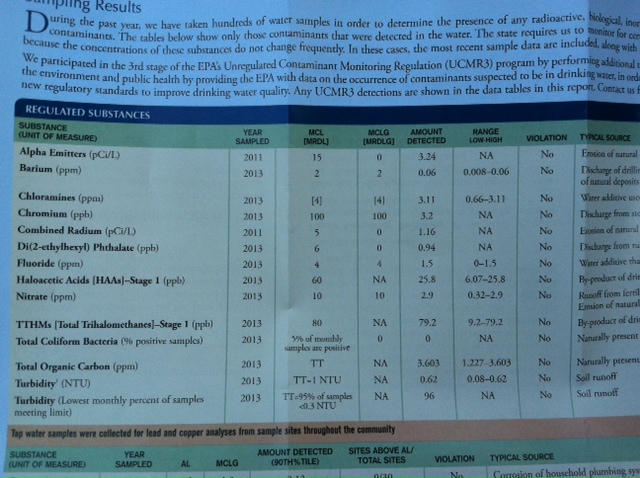
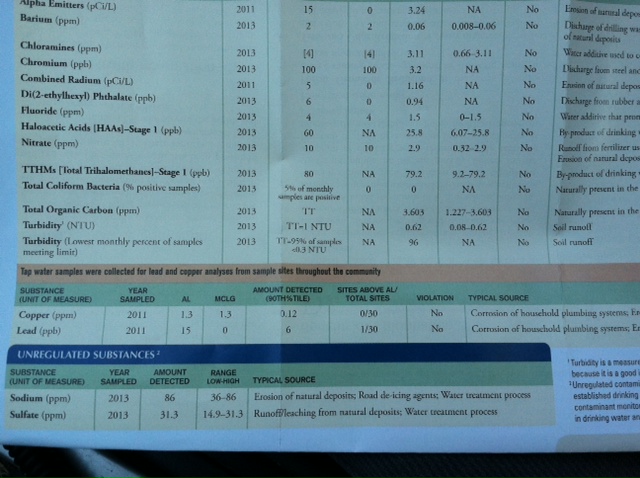
As you can see, the majority of the levels listed are within, albeit at the high end, EPA regulations. So, why may that be of concern? When is the water being tested? Where is it being tested? Is it tested immediately after treatment? Or, when the chemicals have dissipated?
The chemical of the day today is chloramines. Oooh, chloramines. What are chloramines? According to the EPA, “chloramines are disinfectants used to treat drinking water. Chloramines are most commonly formed when ammonia is added to chlorine…the most typical purpose of chloramines is to protect water quality as it moves through pipes.” Chloramines are used to decrease the number of potentially harmful disinfectant by-products (DBPs) from chlorine treated water.
What are DBPs? Richardson, et al (2012) states DBPs are “an unintended consequence of using chemical disinfectants to kill harmful pathogens in water. DBPs are formed by the reaction of disinfectants with naturally occurring organic matter, bromide, and iodide, as well as from anthropogenic pollutants.” According to the EPA, “water that contains chloramines and meets EPA regulatory standards is safe to use for drinking, cooking, bathing, and other household uses. ” Within the same pdf, the EPA states, more than once, that chloramines produce less regulated DBPs than chlorine. Regulated. The EPA was very clear on italicizing regulated. What about unregulated DBPs?
Researchers are finding that “several cases of emerging DBPs are increased in formation with the use of alternative disinfectants (e.g., chloramines), including nitrogen-containing DBPs (N-DBPs), which are generally more genotoxic and cytotoxic than those without nitrogen.” There have been a few studies in communities which show an increase in blood lead levels (BLLs) in children with the use of chloramines in drinking water. Miranda, et al (2007), states “introducing chloramines to reduce carcinogenic by-products may increase exposure to lead in drinking water.” But, water that contains chloramines and meets EPA regulatory standards is safe to drink…
Where is the water being tested? Are there lead pipes from the water supply source to your house, from your house to your faucet? Is the water testing division measuring lead levels in resident’s homes, particularly those who own older houses?
_________________________________________________________________________
Sources:
EPA
Miranda, ML, Kim, D, Hull, AP, Paul, CJ, Overstreet Galeano, MA. 2007. Changes in Blood Lead Levels Associated with Use of Chloramines in Water Treatment Systems. Environmental Health Perspectives 115(2): 221-225.
Richardson, SD and Postigo, C. 2012. Drinking Water Disinfection By-Products. Emerging Organic Contaminants and Human Health: The Handbook of Environmental Chemistry: 93-137.

 On A Limb Movement & Wellness